

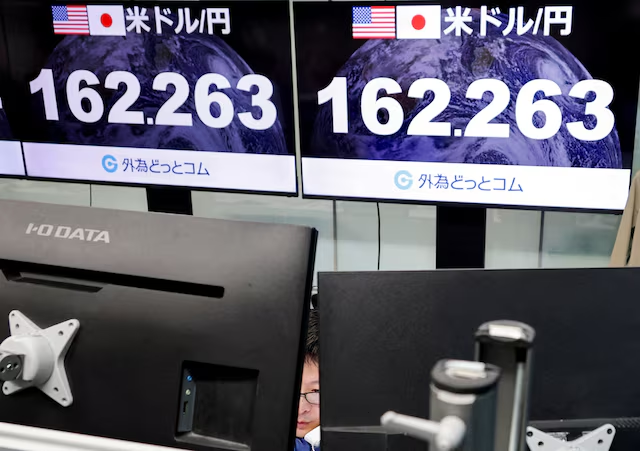
An employee of the foreign exchange trading company Gaitame.com works in front of monitors displaying the current Japanese Yen exchange rate against the U.S. dollar, at its dealing room in Tokyo, Japan, June 30, 2026. REUTERS/Kim Kyung-Hoon/File Photo
SEOUL/SINGAPORE/LONDON, July 31 (Reuters) - Japan and South Korea both stepped in to buy their currencies on Thursday, sources and analysts said, while signs of U.S. support grew on Friday in a rare coordinated intervention that marks an escalation in efforts to stem currency weakness.
The intervention gave the yen its biggest boost in almost two years and, if the past is any guide, any joint effort with the U.S. may prove strong enough to turn around the battered currency.
"It helps to give the story more credibility, that it could be more durable, that at least the Ministry of Finance in Japan is not fighting everyone else," said Dominic Bunning, head of G10 FX strategy at Nomura in London.
Japan conducted its yen-buying intervention in New York hours on Thursday, a market source told Reuters. Bank of Japan data suggested Japan may have sold as much as $58.97 billion to support the yen, though definitive figures are not due for another month.
U.S. MAY STEP IN
Reuters reported that the U.S. Treasury had informed a number of banks that it may intervene in the yen market on Friday, and that banks should "stand ready for future action", citing a source.
"This fits with the view in the market that the New York Fed has been carrying rate checks, so it's adding to the nervousness of market participants that there could be further intervention," said Lee Hardman, currency strategist at MUFG.
The Nikkei newspaper earlier reported that U.S. authorities had conducted rate checks on Thursday – asking banks at what rate they would sell currency – often seen as a precursor to intervention.
A separate source said South Korea's foreign exchange authorities were selling dollars alongside Japan on Thursday.
"We are receiving support from the United States that goes beyond psychological support, and I'm constantly in contact with relevant authorities," Japan's top currency diplomat Atsushi Mimura said, when asked about the possibility of coordinated intervention with the United States.
The intervention has lifted the yen off recent 40-year lows, although the currency handed back some of its gains on Friday as the BOJ held interest rates steady, as expected.
DOUBLE THE IMPACT
Thursday's move in the yen came around the same time as the Korean won firmed 2% to its highest in nine months.
"The interests of each country aligned. For Korea-Japan cooperation, the won and the yen are so tightly coupled that a joint intervention could double the impact," said Lee Min-hyuk, an analyst at KB Kookmin Bank in South Korea.
Japan has intervened in currency markets in coordination with the U.S. or other G7 partners five times since 1985, and eight times on its own, according to an analysis by currency strategist and trader Brent Donnelly at Spectra Markets.
Most of the joint interventions coincided with a turn in the direction of the dollar/yen pair, his analysis shows.
Yet Nomura's Bunning cautioned that this does not resemble the coordinated intervention of March 2011, when global central banks stepped in to stabilise the yen after the devastating earthquake.
"This is not that story," Bunning said. "It is tacit support more so than explicit coordinated intervention."
YEN BEARS LURK
Analysts note that interventions are unlikely to help the frail yen in the longer term unless the BOJ follows through with rate hikes and other factors align, such as a move lower in U.S. rates.
The yen was last at 159.27 per dollar, little changed on the day, after strengthening to as much as 157.8 on Thursday.
The currency saw a further bout of short-lived strength during the European morning on Friday, although it was not immediately clear what drove the move, or whether Japanese authorities were again in the market.
The BOJ kept rates steady at 1% on Friday, but warned for the first time that underlying inflation could exceed its target, signalling another rate hike could be on the cards as soon as September.
The won, which hit a 17-year low of 1,561.50 per dollar last month, was 1% weaker on Friday. It has gained more than 7.5% this month on the back of companies repatriating dollars into South Korea.
Reporting by Yena Park, Cynthia Kim and Jihoon Lee in Seoul; Leika Kihara, Takaya Yamaguchi and Makiko Yamaguch in Tokyo, Tom Westbrook and Ankur Banerjee in Singapore, Samuel Indyk in London; Writing by Ankur Banerjee in Singapore and Samuel Indyk in London; Editing by Raju Gopalakrishnan and David Holmes
Our Standards: