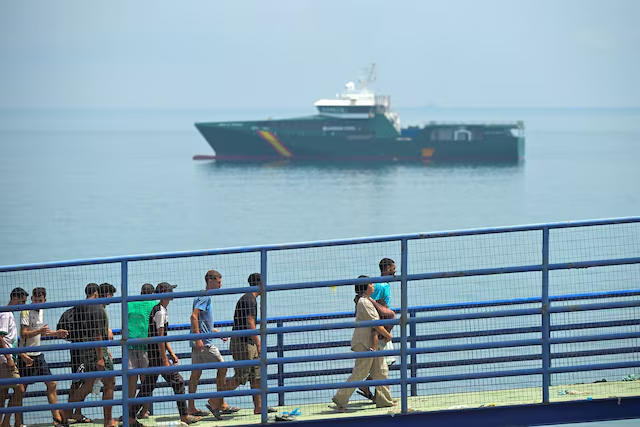
Migrants walk towards the border with Morocco to leave Spain, amid mass crossings of migrants on foot and by sea from Morocco into Spanish territory, in Ceuta, Spain, July 31, 2026. REUTERS/Fabian Bimmer Purchase Licensing Rights, opens new tab
Summary
Spain says smugglers exploited July court ruling
Migrants cite online videos of successful crossings as trigger
Government will install maritime buoys to mark border
MADRID/CEUTA, July 31 (Reuters) - As 16-year-old Moroccan Ayoub El Abyad scrolled through Instagram videos showing migrants crossing into the Spanish enclave of Ceuta, he and his cousin, then still a 12-hour drive from the border, decided to try their luck.
"Migration is about improving our lives. We agreed we would try the idea of crossing and trust in Allah," El Abyad told Reuters on the Moroccan side near the border with Ceuta, after completing the journey by hitching rides with two drivers.
El Abyad was hoping to be one of roughly 60,000 migrants who entered the Spanish territory of Ceuta from Morocco this week, in the biggest surge in recent history.
In Morocco, where deep-seated anger towards poor public services and poverty spilled over late last year into major protests, many young people spend years waiting for a chance to cross the border in search of better prospects.
A quarter of Moroccans aged between 15 and 24 are not in education, employment or training, official data show.
When reports spread on social media about a Spanish Supreme Court ruling earlier in July that migrants intercepted at sea while trying to reach Ceuta or Melilla could not be immediately turned back, many saw an opportunity.
And calm seas at this time of year make swimming a more feasible option for migrants, said Mauricio Valiente, director of Spanish refugee charity CEAR.
"I came here to seek a better future," said Dounia Kherradi, a waitress from Lqliaa, a centre of last year's protests. "My salary is not enough to take care of my parents and I have a daughter... may God help us."
FALSE INFORMATION
Spain's Socialist government, which has generally taken a positive stance on migration, responded firmly to the surge. Prime Minister Pedro Sanchez called it a "violation of Spanish sovereignty" and pledged to return migrants to their countries of origin as quickly as possible.
The foreign ministry blamed misleading information online that suggested migrants arriving by sea would be allowed to stay in Spain. While the court ruling ended immediate pushbacks, it still allows returns through normal legal procedures.
Sanchez said Spain was considering changes to immigration law to strengthen repatriation measures.
As an interim measure, he said the government would install maritime buoys to signal a border in the sea.
DIPLOMATIC TENSIONS?
Some analysts have questioned whether Moroccan authorities turned a blind eye to the crossings, noting previous occasions when Rabat was accused of using migration as political leverage.
The last major surge occurred in May 2021, when Moroccan authorities appeared to relax border controls, a move widely interpreted as retaliation for Spain's hosting of a Western Sahara independence leader.
Morocco does not recognise Spanish sovereignty over Ceuta and the other Spanish enclave, Melilla, characterising the territories - both in Spanish hands for several centuries - as "occupied".
Relations between Madrid and Rabat have improved in recent years after Spain backed Morocco's autonomy plan for Western Sahara, a territory claimed by Morocco but also sought as an independent state by the Algeria-backed Polisario Front.
However, Sanchez's visit to Algeria earlier this month was "not viewed positively in Rabat", said Haizam Amirah-Fernandez, director of the Centre for Contemporary Arab Studies in Madrid.
Spain's Congress also recently approved a bill granting Spanish nationality to the descendants of Sahrawis, a move which experts say likely angered Morocco.
"One way of handling that is to send a not very subtle message," Amirah-Fernandez said.
Morocco's government has not responded to multiple requests for comment on the crossings.
Some commentators noted that the highest volume of crossings occurred on Throne Day, a major public holiday in Morocco marking the anniversary of King Mohammed VI's coronation, when most government offices are closed.
In 2021, Morocco's foreign minister attributed the lax response by border authorities to the wave of migrants to "fatigue" among Moroccan police after Ramadan celebrations.
Lahcen Haddad, who heads a Moroccan parliamentary committee on EU relations, rejected suggestions that politics played a role, echoing Spain's official interpretation that the crossings were triggered by misinformation about the Supreme Court ruling.
Spain's foreign ministry said on Thursday bilateral ties with Morocco were "excellent and not affected by our good relationship with Algeria."
(This story has been corrected to say that the comment was made near the border with Ceuta on the Moroccan side, not in Ceuta, in paragraph 2)
Reporting by Victoria Waldersee and Ahmed Eljechtimi; additional reporting by Corina Pons
Editing by Andrei Khalip and Ros Russell