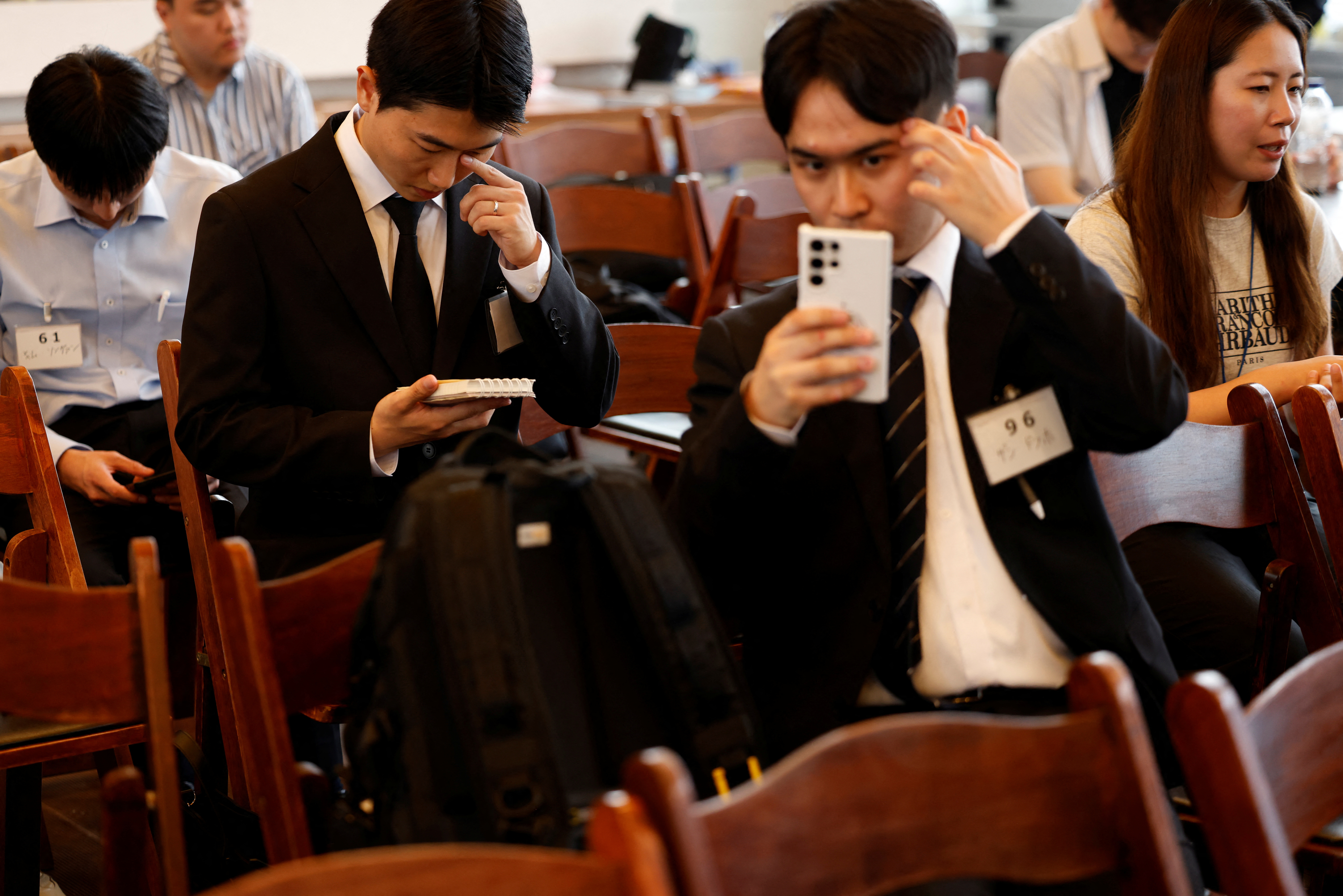
A South Korean job seeker checks his appearance using a smartphone as another reviews his notes before an interview at a job fair in Seoul, South Korea, July 12, 2026. REUTERS/Kim Soo-hyeon
Summary
Companies
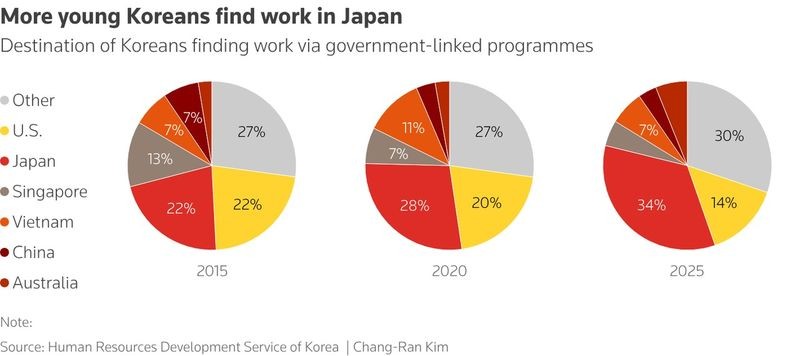
Japan was top destination for young Koreans finding jobs through state-backed programmes last year
South Korea's youth unemployment rate at 7.0% in June, Japan desperate for workers
Seoul has hosted at least three Japan-focused job fairs this year
Japanese firms value Korean candidates' language skills, academic rigour, cultural fit
Korean applicants are drawn to Japanese employers' willingness to train new hires
SEOUL/TOKYO, Aug 3 (Reuters) - When Japanese entrepreneur Moe Kasugai was a student at Seoul's Yonsei University, she was struck by how some of the prestigious South Korean college's brightest graduates struggled to land a job.
So in 2019 she launched a service to connect Korean job seekers with Japanese employers.
"I was surprised that they couldn't find a job because they were so smart,” the 35-year-old said in Seoul at a two-day job fair organised by KOREC, her startup, last month. "Many could speak Japanese, so I thought it might be better for them to go to Japan. I wanted to help."
South Korean youth face a chronic shortage of desirable entry-level jobs, as big name employers such as Samsung prefer to hire experienced workers and many older people remain in their jobs. In ageing Japan, meanwhile, companies are struggling to fill positions in large graduate schemes offering structured training to those taking the first step in their careers.
In a sign of the growing demand — and despite average salaries now being slightly higher in South Korea than in Japan — South Korea's Wanted Lab (376980.KQ), opens new tab and Japan’s LAPRAS, both of which specialise in tech talent placement, this year launched similar services to KOREC, joining early mover Mynavi.
The South Korean capital has also hosted at least three Japan-focused job fairs this year, with hiring companies such as Canon Imaging Systems and industrial automation group Azbil (6845.T), opens new tab. According to the latest monthly data for June, South Korea’s youth unemployment rate was 7.0% while Japan's overall rate was 2.5%.
While the vast majority of foreigners with work visas in Japan hold blue-collar jobs, the 80,000-plus Koreans working in the country commonly fill professional roles in sectors such as retail, IT and game development, according to the Korea Labor Institute.
The Human Resources Development Service of Korea recorded 2,257 young Koreans taking jobs in Japan last year through government-backed programmes, marking a 47% jump from 2024 and making Japan their top destination for working overseas. For the U.S., the figure dropped 29%.
More young Koreans find work in Japan - These pie charts show the growing popularity of Japan as the destination for young South Koreans seeking work abroad. View interactive graphic
KOREAN TALENT FILLS JAPANESE GAPS
Despite a sometimes fractious relationship between the two democracies, mostly over Japan's past colonial rule of Korea, it is not only in employment where ties are growing.
In 2025, marriages between Korean men and Japanese women jumped 26% from the previous year to double the number in 2020, while Korean women marrying Japanese men surged 29% despite a flat overall international-marriage market, according to South Korea’s statistics agency.
A record number of South Koreans have visited Japan this year and now account for the country’s biggest group of inbound tourists.
"Most people I know who are looking for jobs in Japan already had an interest in living there," said college student Kim Si-hyeon, who was among the more than 100 job seekers at the KOREC-hosted event. Many, like Kim, are drawn to the prospect of receiving on-the-job training at a Japanese company — something Korean firms do not typically offer fresh graduates.
"Korean companies tend to prefer experienced workers, while Japanese companies still recruit new graduates,” the fourth-year Japanese studies student at Dongguk University said, adding she was looking for work in information technology or AI.
Lee Chang-min, a professor at Hankuk University of Foreign Studies, said the South Korean labour pool was especially attractive for Japanese companies.
“In terms of language and culture, the quality of Korean candidates is overwhelmingly high. There aren't many foreign applicants who can use Japanese at the level required for actual work," he said.
Tomoya Hattori, head of Japanese consultancy Energize, said he was not so concerned about the nationality of those he recruited, but said he found Korean candidates' competitiveness, speed and diligence appealing.
"If there's a good candidate, we want to hire that person," he said at the job fair.
CHALLENGES IN RETENTION
Hiring foreign talent also presents challenges for Japanese companies, however. Many Koreans like to switch jobs for career advancement and better pay, KOREC's Kasugai said, creating problems with retention in Japanese firms, which are more used to lifetime employment.
"It's definitely a stumbling block for Japanese companies," she said. "Still, young Japanese people are job-hopping more and more these days, so I think Japanese companies' understanding will eventually adjust."
The risk of a foreign worker leaving is particularly high if training takes a long time, there are limited opportunities to apply skills beyond a narrowly defined company role, and promotion is slow, Hankuk University's Lee said.
But for Kasugai, who once considered a career as a diplomat and speaks flawless Korean, the placements serve a deeper purpose: an opportunity to forge cross-border understanding.
“When (Korean) people go there and work, exchanges begin with Japanese colleagues who may never have had a Korean friend or known much about Korean culture,” she said. “That's something a private company can help create."
Reporting by Kyu-seok Shim in Seoul, Chang-Ran Kim and Kentaro Okasaka in Tokyo; Editing by Kate Mayberry